
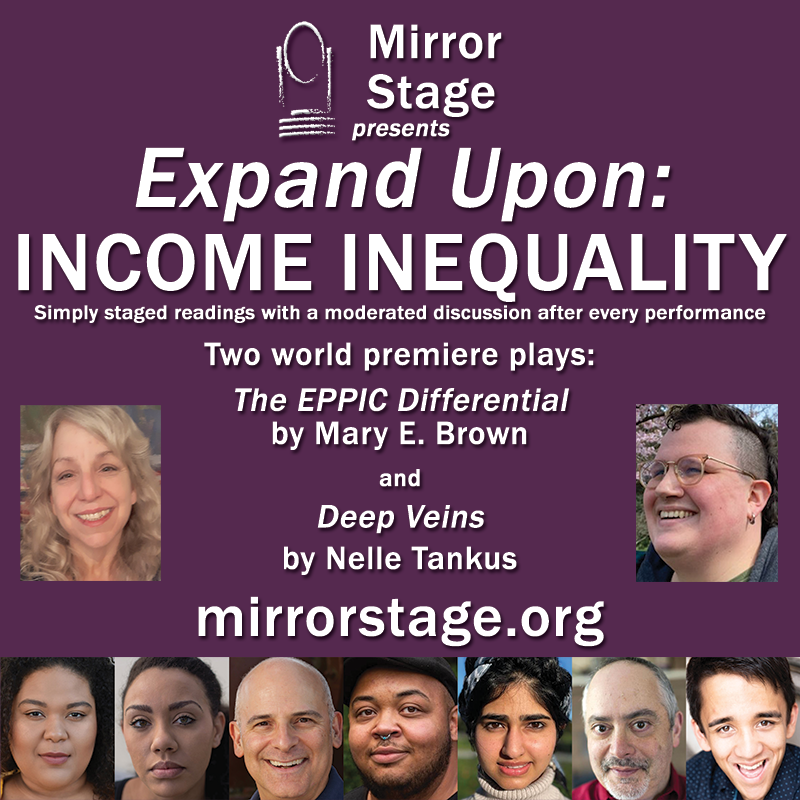
For the seventh round of Expand Upon, the community selected the theme Income Inequality and the Wage Gap, and Mirror Stage commissioned The EPPIC Differential by Mary E. Brown and Deep Veins by Nelle Tankus. Performances of Expand Upon: INCOME INEQUALITY were online October 15, 16, 22, and 23—Saturdays at 7:30pm and Sundays at 2:00pm, Pacific. Directed by QuiQui Dominguez, Expand Upon: INCOME INEQUALITY featured Roz Cornejo, Hazel Rose Gibson, Andrew Litzky, Alex Lee Reed, Anubhuti Sood, Steven Sterne, and Matty Sythandone. A moderated discussion with artists and audience exploring the issues raised in more depth followed every performance.
Mirror Stage now offers Radical Hospitality pricing. Every performance offers 20 FREE tickets (first come, first served) plus 10 Pay-What-You-Can tickets ($1 minimum). Tickets are also available at “Select Your Own Price” of $5, $15, or $30.

No stranger to the “Wealth Gap,” Mary E. Brown was honored to be asked to participate as a playwright in Mirror Stage’s Expand Upon series this year. The first of her written plays that were semi-publicly performed occurred at the tender age of ten, and while Mary has spent her most recent years creating scripts for children, she appreciates the challenge of writing plays for, and performed by “grown ups.” In addition to being a teacher, she is an active participant in various disciplines within the Seattle theater community. Mary dedicates this script to the loving memory of her brother, Ed.

Nelle Tankus is a white Jewish & Romani trans woman playwright. Her full-length work has been seen in Seattle at 12th Avenue Arts (The Untitled Play About Art School, dir. L. Nicol Cabe), with The Umbrella Project (Slack Water, dir. QuiQui Dominguez), and in New York City at IRT Theatre (Hunting, dir. Tristan Powell). Her shorter plays have been seen at Mo-Wave, The Pocket Theater, Volunteer Park, The Erickson Theater, Seattle Town Hall, and have been presented in association with MAP Theatre, ACT’s 1-Minute Play Festival, Fantastic Z. Theatre Company, Annex Theatre’s Spin the Bottle, and Forward Flux. Most recently, she was part of the 2021 María Irene Fornés Playwrights Workshop cohort. She is based in Seattle.
Income inequality refers to the extent to which income is distributed in an uneven manner among a population, whether segmented by gender, ethnicity, geographic location, occupation, and/or historical income. In the United States, the income gap between the rich and everyone else has been growing markedly, by every major statistical measure, for more than 30 years. Income disparities are so pronounced that America’s top 10 percent now average more than nine times as much income as the bottom 90 percent, according to data analyzed by UC Berkeley economist Emmanuel Saez. The top 1% in the U.S. average over 39 times more income than the bottom 90 percent, and the nation’s top 0.1 percent are taking in more than 196 times the income of the bottom 90 percent.
The U.S. income divide has not always been as vast as it is today. In the early 20th century, social movements and progressive policymakers fought successfully to level down the top through fair taxation and level up the bottom through increased unionization and other reforms. But beginning in the 1970s, these levelers started to erode and the country returned to extreme levels of inequality. As the share of the workforce represented by a union has declined to less than 11 percent since their peak, those at the top of the income scale have increased their power to rig economic rules in their favor, further increasing income inequality.
Men make up an overwhelming majority of top earners across the U.S. economy, even though women now represent almost half of the country’s workforce. Racial discrimination in many forms, including in education, hiring, and pay practices, contributes to persistent earnings gaps. In 2020, Fortune 500 CEOs, who earned approximately $15.5 million on average, included just five Black people and 17 Latinx people — less than 5 percent of the total—although Black people and Latino people comprise 31.9 percent of the entire U.S. population. By contrast, these groups made up 44.1 percent of the U.S. workers who would benefit from a raise in the federal minimum wage to $15 per hour by 2025, according to the Economic Policy Institute. As of the second quarter of 2021, the median White worker made 27 percent more than the typical Black worker and around 30 percent more than the median Latinx worker, according to BLS data.
Mirror Stage gratefully acknowledges the support of 4Culture, ArtsWA, City of Seattle Office of Arts & Culture, the EPS Fund, Humanities Washington, the National Endowment for the Arts, the National Endowment for the Humanities, and the Posner-Wallace Foundation.